Choose the product behind the offer
Sign in to save your progressAt North Mill Coffee, owners of Field hand grinder can use Field travel case. To offer the accessory, find customers who bought the first product and have yet to buy the second.
In Contacts → Lists and Segments → New List, choose Automations and Customers with Optin. Under More → Edit filters, include the exact product under Products purchased and exclude the accessory under Products NOT purchased. Choose the order statuses your shop counts.
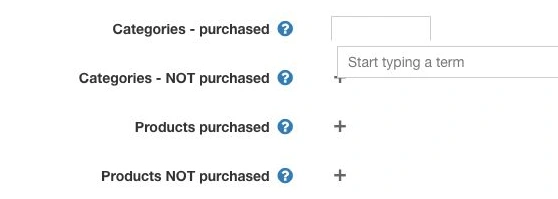
In Test Segmentation, compare Mira, who bought the product and later bought “House espresso · 1 kg”, with Jo, who already bought the accessory. Predict both results. The practice below changes the goal to a repeat purchase.
Try it with your shop
Alex looked at repeat orders for “House espresso · 1 kg”. Regular buyers at North Mill Coffee often reorder 28–35 days after their last purchase of this pack. The smaller pack “House espresso · 250 g” has its own product ID. For “Field hand grinder”, a useful follow-up would show the buyer how to adjust the grind for the first cup.
In Contacts → Lists and Segments, create an automation audience for subscribed customers. Under Products purchased, select the exact product, the order statuses your shop counts and the age of the last matching purchase. The example shop counts dispatched orders.
Try again. An unrelated purchase could reset that clock even though the pack is nearly used up.
Correct. That gives you a clock for this particular pack. Use 28–35 days for this fictional shop.
Try again. The smaller size has a separate ID. The observed interval came from orders for the selected size.
Worked example
At North Mill Coffee, “Field travel case” fits “Field hand grinder”. Another model in the same category needs a different accessory. Require the matching product ID and exclude buyers of the accessory. Test a buyer who owns only the other model.
Compare shop examples
- Coffee & equipment · North Mill Coffee
- Pet food & equipment · Paw & Pine
- Wine & cellarware · Terrace Cellars
- Clothing & care · Linden Knitwear
- Electronics & supplies · Pixel & Paper
Coffee & equipment · North Mill Coffee
At North Mill Coffee, owners of Field hand grinder can use Field travel case. To offer the accessory, find customers who bought the first product and have yet to buy the second.
In Test Segmentation, compare Mira, who bought the product and later bought “House espresso · 1 kg”, with Jo, who already bought the accessory. Predict both results. The practice below changes the goal to a repeat purchase.
At North Mill Coffee, “Field travel case” fits “Field hand grinder”. Another model in the same category needs a different accessory. Require the matching product ID and exclude buyers of the accessory. Test a buyer who owns only the other model.
Alex looked at repeat orders for “House espresso · 1 kg”. Regular buyers at North Mill Coffee often reorder 28–35 days after their last purchase of this pack. The smaller pack “House espresso · 250 g” has its own product ID. For “Field hand grinder”, a useful follow-up would show the buyer how to adjust the grind for the first cup.
In Contacts → Lists and Segments, create an automation audience for subscribed customers. Under Products purchased, select the exact product, the order statuses your shop counts and the age of the last matching purchase. The example shop counts dispatched orders.
Which purchase should start the reorder clock?
- The latest order across the shop. An unrelated purchase could reset that clock even though the pack is nearly used up.
- The latest qualifying purchase of “House espresso · 1 kg”. Correct. That gives you a clock for this particular pack. Use 28–35 days for this fictional shop.
- The purchase of any size in its category. The smaller size has a separate ID. The observed interval came from orders for the selected size.
Pet food & equipment · Paw & Pine
At Paw & Pine, owners of Trail walking harness can use Trail clip-on pouch. To offer the accessory, find customers who bought the first product and have yet to buy the second.
In Test Segmentation, compare Lina, who bought the product and later bought “Meadow kibble · 4 kg”, with Robin, who already bought the accessory. Predict both results. The practice below changes the goal to a repeat purchase.
At Paw & Pine, “Trail clip-on pouch” fits “Trail walking harness”. Another model in the same category needs a different accessory. Require the matching product ID and exclude buyers of the accessory. Test a buyer who owns only the other model.
Sam looked at repeat orders for “Meadow kibble · 4 kg”. Regular buyers at Paw & Pine often reorder 19–25 days after their last purchase of this pack. The smaller pack “Meadow kibble · 1 kg” has its own product ID. For “Trail walking harness”, a useful follow-up would show the buyer how to adjust the harness before the first walk.
In Contacts → Lists and Segments, create an automation audience for subscribed customers. Under Products purchased, select the exact product, the order statuses your shop counts and the age of the last matching purchase. The example shop counts dispatched orders.
Which purchase should start the reorder clock?
- The latest order across the shop. An unrelated purchase could reset that clock even though the pack is nearly used up.
- The latest qualifying purchase of “Meadow kibble · 4 kg”. Correct. That gives you a clock for this particular pack. Use 19–25 days for this fictional shop.
- The purchase of any size in its category. The smaller size has a separate ID. The observed interval came from orders for the selected size.
Wine & cellarware · Terrace Cellars
At Terrace Cellars, owners of Arc glass decanter can use Arc drying stand. To offer the accessory, find customers who bought the first product and have yet to buy the second.
In Test Segmentation, compare Nico, who bought the product and later bought “Hillside Riesling · 6 bottles”, with Leonie, who already bought the accessory. Predict both results. The practice below changes the goal to a repeat purchase.
At Terrace Cellars, “Arc drying stand” fits “Arc glass decanter”. Another model in the same category needs a different accessory. Require the matching product ID and exclude buyers of the accessory. Test a buyer who owns only the other model.
Eva looked at repeat orders for “Hillside Riesling · 6 bottles”. Regular buyers at Terrace Cellars often reorder 70–90 days after their last purchase of this pack. The smaller pack “Hillside Riesling · 2 bottles” has its own product ID. For “Arc glass decanter”, a useful follow-up would show the buyer how to pour from the decanter without dripping.
In Contacts → Lists and Segments, create an automation audience for subscribed customers. Under Products purchased, select the exact product, the order statuses your shop counts and the age of the last matching purchase. The example shop counts dispatched orders.
Which purchase should start the reorder clock?
- The latest order across the shop. An unrelated purchase could reset that clock even though the pack is nearly used up.
- The latest qualifying purchase of “Hillside Riesling · 6 bottles”. Correct. That gives you a clock for this particular pack. Use 70–90 days for this fictional shop.
- The purchase of any size in its category. The smaller size has a separate ID. The observed interval came from orders for the selected size.
Clothing & care · Linden Knitwear
At Linden Knitwear, owners of Alder merino pullover can use Alder care kit. To offer the accessory, find customers who bought the first product and have yet to buy the second.
In Test Segmentation, compare Amir, who bought the product and later bought “Wool wash · 12 sachets”, with Ida, who already bought the accessory. Predict both results. The practice below changes the goal to a repeat purchase.
At Linden Knitwear, “Alder care kit” fits “Alder merino pullover”. Another model in the same category needs a different accessory. Require the matching product ID and exclude buyers of the accessory. Test a buyer who owns only the other model.
Tessa looked at repeat orders for “Wool wash · 12 sachets”. Regular buyers at Linden Knitwear often reorder 90–120 days after their last purchase of this pack. The smaller pack “Wool wash · 3 sachets” has its own product ID. For “Alder merino pullover”, a useful follow-up would show the buyer how to dry the pullover flat after washing.
In Contacts → Lists and Segments, create an automation audience for subscribed customers. Under Products purchased, select the exact product, the order statuses your shop counts and the age of the last matching purchase. The example shop counts dispatched orders.
Which purchase should start the reorder clock?
- The latest order across the shop. An unrelated purchase could reset that clock even though the pack is nearly used up.
- The latest qualifying purchase of “Wool wash · 12 sachets”. Correct. That gives you a clock for this particular pack. Use 90–120 days for this fictional shop.
- The purchase of any size in its category. The smaller size has a separate ID. The observed interval came from orders for the selected size.
Electronics & supplies · Pixel & Paper
At Pixel & Paper, owners of Pocket P2 photo printer can use Pocket P2 carrying case. To offer the accessory, find customers who bought the first product and have yet to buy the second.
In Test Segmentation, compare Noor, who bought the product and later bought “P2 photo paper · 50 sheets”, with Finn, who already bought the accessory. Predict both results. The practice below changes the goal to a repeat purchase.
At Pixel & Paper, “Pocket P2 carrying case” fits “Pocket P2 photo printer”. Another model in the same category needs a different accessory. Require the matching product ID and exclude buyers of the accessory. Test a buyer who owns only the other model.
Ken looked at repeat orders for “P2 photo paper · 50 sheets”. Regular buyers at Pixel & Paper often reorder 35–49 days after their last purchase of this pack. The smaller pack “P2 photo paper · 20 sheets” has its own product ID. For “Pocket P2 photo printer”, a useful follow-up would show the buyer how to pair the P2 printer with a phone.
In Contacts → Lists and Segments, create an automation audience for subscribed customers. Under Products purchased, select the exact product, the order statuses your shop counts and the age of the last matching purchase. The example shop counts dispatched orders.
Which purchase should start the reorder clock?
- The latest order across the shop. An unrelated purchase could reset that clock even though the pack is nearly used up.
- The latest qualifying purchase of “P2 photo paper · 50 sheets”. Correct. That gives you a clock for this particular pack. Use 35–49 days for this fictional shop.
- The purchase of any size in its category. The smaller size has a separate ID. The observed interval came from orders for the selected size.